Building Confidence in Cryptographic Protocols

An introduction to formal analysis and our proof of the security of KEMTLS

Good morning everyone, and welcome to another Post-Quantum–themed blog post! Today we’re going to look at something a little different. Rather than look into the past or future quantum we’re going to look as far back as the ‘80s and ‘90s, to try and get some perspective on how we can determine whether a protocol is or is not secure. Unsurprisingly, this question comes up all the time. Cryptographers like to build fancy new cryptosystems, but just because we, the authors, can’t break our own designs, it doesn’t mean they are secure: it just means we are not smart enough to break them.
One might at this point wonder why in a post-quantum themed blog post we are talking about security proofs. The reason is simple: the new algorithms that claim to be safe against quantum threats need proofs showing that they actually are safe. In this blog post, not only are we going to introduce how we go about proving a protocol is secure, we’re going to introduce the security proofs of KEMTLS, a version of TLS designed to be more secure against quantum computers, and give you a whistle-stop tour of the formal analysis we did of it.
Let’s go back for the moment to not being smart enough to break a cryptosystem. Saying “I tried very hard to break this, and couldn’t” isn’t a very satisfying answer, and so for many years cryptographers (and others) have been trying to find a better one. There are some obvious approaches to building confidence in your cryptosystem, for example you could try all previously known attacks, and see if the system breaks. This approach will probably weed out any simple flaws, but it doesn’t mean that some new attack won’t be found or even that some new twist on an old one won’t be discovered.
Another approach you can take is to offer a large prize to anyone who can break your new system; but to do that not only do you need a big prize that you can afford to give away if you’re wrong, you can’t be sure that everyone would prefer your prize to, for example, selling an attack to cybercriminals, or even to a government.
Simply trying hard, and inducing other people to do so too still felt unsatisfactory, so in the late ‘80s researchers started trying to use mathematical techniques to prove that their protocol was secure. Now, if you aren’t versed in theoretical computer science you might not even have a clear idea of what it even means to “prove” a protocol is secure, let alone how you might go about it, so let’s start at the very begiing.
A proof
First things first: let’s nail down what we mean by a proof. At its most general level, a mathematical proof starts with some assumptions, and by making logical inferences it builds towards a statement. If you can derive your target statement from your initial assumptions then you can be sure that, if your assumptions are right, then your final statement is true.
Euclid’s famous work, The Elements, a standard math textbook for over 2,000 years, is written in this style. Euclid gives five “postulates”, or assumptions, from which he can derive a huge portion of the geometry known in his day. Euclid’s first postulate, that you can draw a straight line between any two points, is never proven, but taken as read. You can take his first postulate, and his third, that you can draw a circle with any center and radius, and use it to prove his first proposition, that you can draw an equilateral triangle given any finite line. For the curious, you can find public-domain translations of Euclid’s work.
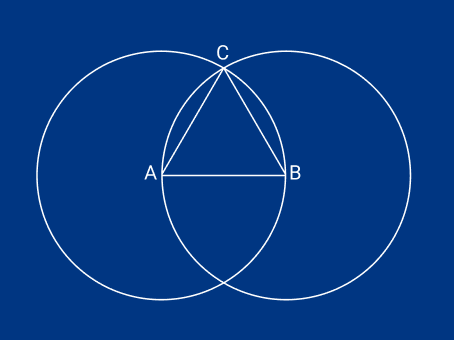
Whilst it’s fairly easy to intuit how such geometry proofs work, it’s not immediately clear how one could prove something as abstract as the security of a cryptographic protocol. Proofs of protocols operate in a similar way. We build a logical argument starting from a set of assumptions. Security proofs, however, can be much, much bigger than anything in The Elements (for example, our proof of the security properties of KEMTLS, which we will talk about later, is nearly 500,000 lines long) and the only reason we are able to do such complex proofs is that we have something of an advantage over Euclid. We have computers. Using a mix of human-guided theorem proving and automated algorithms we can prove incredibly complex things, such as the security of protocols as the one we will discuss.
Now we know that a proof is a set of logical steps built from a set of assumptions, let’s talk a bit about how security proofs work. First, we need to work out how to describe the protocol in terms that we can reason about. Over the years researchers have come up with many ways for describing computer processes mathematically, most famously Alan Turing defined a-machines, which we now know as Turing Machines, which describe a computer program in an algebraic form. A protocol is slightly more complex than a single program. A protocol can be seen as a number of computers ruing a set of computer programs that interact with each other.
We’re going to use a class of techniques called process algebras to describe the interacting processes of a protocol. At its most basic level, algebra is the art of generalizing a statement by replacing specific values with general symbols. In standard algebra, these specific values are numbers, so for example we can write (cos 37)² + (sin 37)² = 1, which is true, but we can generalize it to (cos θ)² + (sin θ)² = 1, replacing the specific value, 37, with the symbol θ.
Now you might be wondering why it’s useful to replace things with symbols. The answer is it lets us solve entire classes of problems instead of solving each individual instance. When it comes to security protocols, this is especially important. We can’t possibly try every possible set of inputs to a protocol and check nothing weird happens to one of them. In fact, one of the assumptions we’re going to make when we prove KEMTLS secure is that trying every possible value for some inputs is impossible1. By representing the protocol symbolically, we can write a proof that applies to all possible inputs of the protocol.
Let’s go back to algebra. A process algebra is similar to the kind of algebra you might have learnt in high school: we represent a computer program with symbols for the specific values. We also treat functions symbolically. Rather than try and compute what happens when we apply a function f to a value x, we just create a new symbol f(x). An algebra also provides rules for manipulating expressions. For example, in standard algebra we can transform y + 5 = x² - x into y = x² - x - 5. A process algebra is the same: it not only defines a language to describe interacting processes, it also defines rules for how we can manipulate those expressions.
We can use tools, such as the one we use called Tamarin, to help us do this reasoning. Every protocol has its own rules for what transformations are allowed. It is very useful to have a tool, like Tamarin, to which we can tell these rules and allow it to do all the work of symbol manipulation. Tamarin does far, far more than that, though.
A rule, that we tell Tamarin, might look like this:
rule Register_pk:
  [ Fr(~ltkA) ]
--[ GenLtk($A, ~ltkA)]->
  [ !Ltk($A, ~ltkA), !Pk($A, pk(~ltkA)), Out(pk(~ltkA)) ]
This rule is used to represent that a protocol participant has acquired a new public/private key pair. The rule has three parts:
- The first part lists the preconditions. In this case, there is only one: we take a
Fresh value called~ltkA, the “long-term key of A”. This precondition is always met, because Tamarin always allows us to generate fresh values. - The third part lists the postconditions (what we get back when we apply the rule). Rather than operating on an initial statement, as in high-school algebra, Tamarin instead operates on what we call a model of “bag of facts”. Instead of starting with
y + 5 = x² - x, we start with an empty “bag”, and from there, apply rules. These rules take facts out of the bag and put new ones in. In this case, we put in:!Ltk($A, ~ltkA)which represents the private portion of the key,~ltkA, and the name of the participant it was issued to,$A.!Pk($A, pk(~ltkA)), which represents the public portion of the key,pk(~ltkA), and the participant was issued to,$A.Out(pk(~ltkA)), which represents us publishing the public portion of the key,pk(~ltkA)to the network. Tamarin is based on the Dolev-Yao model, which assumes the attacker controls the network. Thus, this fact makes$A’s public key available to the attacker.
We can only apply a rule if the preconditions are met: the facts we need appear in the bag. By having rules for each step of the protocol, we can apply the rules in order and simulate a run of the protocol. But, as I’m sure you’ve noticed, we skipped the second part of the rule. The second part of the rule is where we list what we call actions.
We use actions to record what happened in a protocol run. In our example, we have the action GenLtk($A, ~ltkA). GenLtk means that a new Long-Term Key (LTK) has been Generated. Whenever we trigger the Register_pk rule, we note this with the two parameters:, $A, the party to whom the new key pair belongs; and ~ltkA, the private part of the generated key2.
If we simulate a single run of the protocol, we can record a list of all the actions executed and put them in a list. However, at any point in the protocol, there may be multiple rules that can be triggered. A list only captures a single run of a protocol, but we want to reason about all possible runs of the protocol. We can arrange our rules into a tree: every time we have multiple rules that could be executed, we give each one of them its own branch.
If we could write this entire tree, it would represent every possible run of the protocol. Because every possible run appears in this tree, if we can show that there are no “bad” runs on this tree, we can be sure that the protocol is “secure”. We put “bad” and “secure” in quotation marks here because we still haven’t actually defined what those terms actually mean.
But before we get to that, let’s quickly recap what we have so far. We have:
- A protocol we want to prove.
- A definition of protocol, as a number of computers ruing a set of computer programs that interact with each other.
- A technique, process algebras, to describe the interacting processes of the protocol: this technique provides us with symbols and rules for manipulating them.
- A tree that represents every possible run of the protocol.
We can reason about a protocol by looking at properties that our tree gives. As we are interested in cryptographic protocols, we would like to reason about its security. “Security” is a pretty abstract concept and its meaning changes in different contexts. In our case, to prove something is secure, we first have to say what our security goals are. One thing we might want to prove is, for example, that an attacker can never learn the encryption key of a session. We capture this idea with a reachability lemma.
A reachability lemma asks whether there is a path in the tree that leads to a specific state: can we “reach” this state? In this case, we ask: “can we reach a state where the attacker knows the session key?” If the answer is “no”, we are sure that our protocol has that property (an attacker never learns the session key), or at least that that property is true in our protocol model.
So, if we want to prove the security of a cryptographic protocol, we need to:
- Define the goals of the security that is being proven.
- Describe the protocol as an interacting process of symbols, rules, and expressions.
- Build a tree of all the steps the protocol can take.
- Check that the trees of protocol runs attain the goals of security we specified.
This process of creating a model of a program and writing rigorous proofs about that model is called “formal analysis”.
Writing formal proofs of protocol correctness has been very effective at finding and fixing all kinds of issues. During the design of TLS 1.3, for example, it uncovered a number of serious security flaws that were eventually fixed prior to standardization. However, something we need to be wary of with formal analysis is being over-reliant on its results. It’s very possible to be so taken with the rigour of the process and of its mathematical proofs, that the result gets overinterpreted. Not only can a mistake exist in a proof, even in a machine-checked one, the proof may not actually prove what you think it does. There are many examples of this: Needham-Schroeder had a proof of security written in the BAN logic, before Lowe found an attack on a case that the BAN logic did not cover.
In fact, the initial specification of the TLS 1.3 proof made the assumption that nobody uses the same certificate for both a client and a server, even though this is not explicitly disallowed in the specification. This gap led to the “Selfie” vulnerability where a client could be tricked into coecting to itself, potentially leading to resource exhaustion attacks.
Formal analysis of protocol designs also tells you nothing about whether a particular implementation correctly implements a protocol. In other blog posts, we will talk about this. Let’s now return to our core topic: the formal analysis of KEMTLS.
Proving KEMTLS’s security
Now that we have the needed notions, let’s get down to the nitty-gritty: we show you how we proved KEMTLS is secure. KEMTLS is a proposal to do authentication in TLS handshakes using key exchange (via key encapsulation mechanisms or KEMs). KEMTLS examines the trade-offs between post-quantum signature schemes and post-quantum key exchange, as we discussed in other blog posts.
The main idea of KEMTLS is the following: instead of using a signature to prove that you have access to the private key that corresponds to the (signing) public key in the certificate presented, we derive a shared secret encapsulated to a (KEM) public key. The party that presented the certificate can only derive (decapsulate) it from the resulting encapsulation (often also called the ciphertext) if they have access to the correct private key; and only then can they read encrypted traffic. A brief overview of how this looks in the “traditional arrows on paper” form is given below.
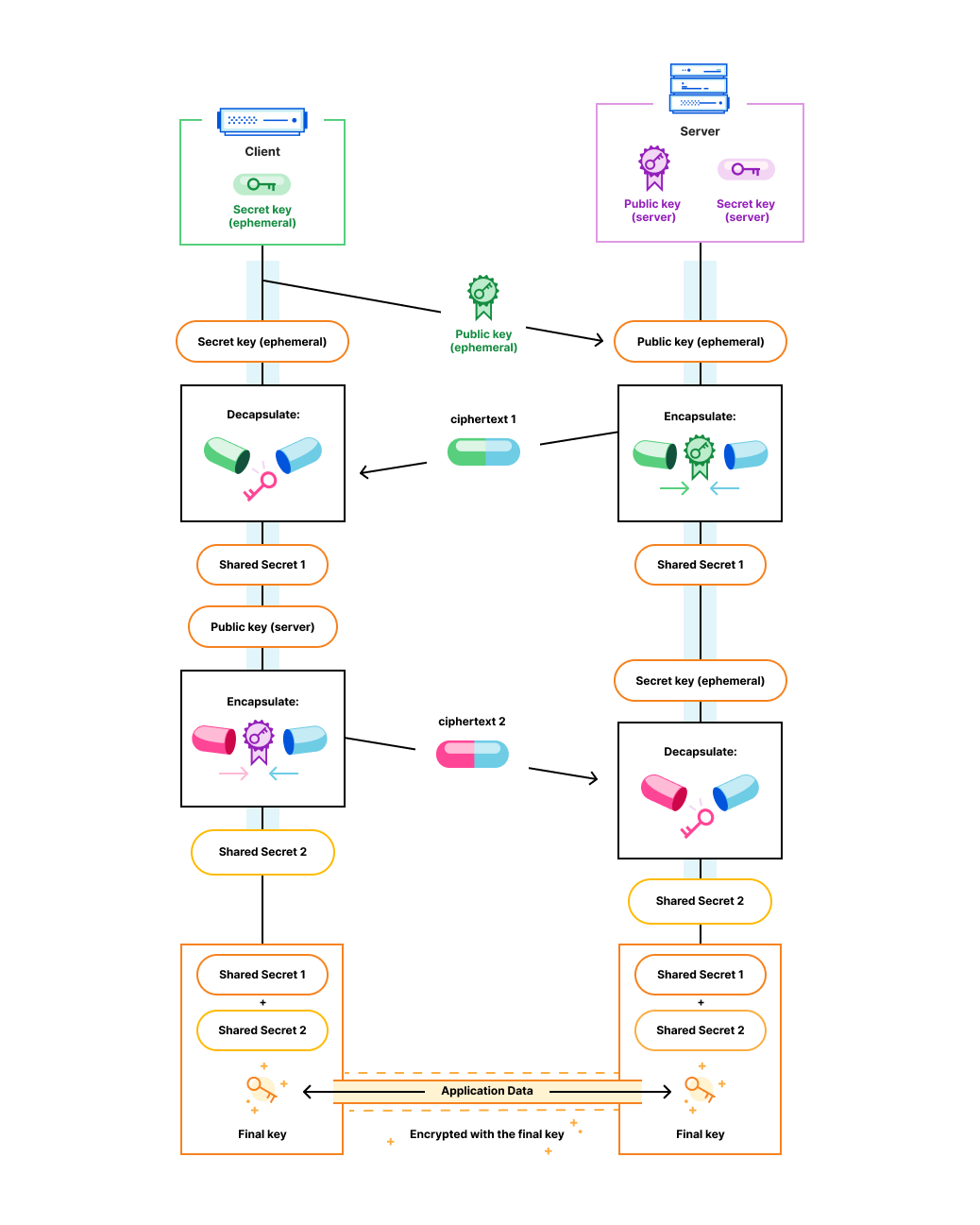
We want to show that the KEMTLS handshake is secure, no matter how an adversary might mess with, reorder, or even create new protocol messages. Symbolic analysis tools such as Tamarin or ProVerif are well suited to this task: as said, they allow us to consider every possible combination or manipulation of protocol messages, participants, and key information. We can then write lemmas about the behavior of the protocol.
Why prove it in Tamarin?
There exists a pen-and-paper proof of the KEMTLS handshake. You might ask: why should we still invest the effort of modeling it in a tool like Tamarin?
Pen-and-paper proofs are in theory fairly straightforward. However, they are very hard to get right. We need to carefully express the security properties of the protocol, and it is very easy to let assumptions lead you to write something that your model does not correctly cover. Verifying that a proof has been done correctly is also very difficult and requires almost as much careful attention as writing the proof itself. In fact, several mistakes in definitions of the properties of the model of the original KEMTLS proof were found, after the paper had been accepted and published at a top-tier security conference.